

Why Do We Have A House And Senate, Anyway? Print All Related Standards

Description

Students learn why there are two houses of Congress and discover how a bicameral legislature ensures that all states have a voice in bills. Together, the class creates a school cell phone policy and experiments with different voting groups that demonstrate why the bicameral compromise was necessary. Students also examine how things might be different today if there were just a House or a Senate. (Recently Updated!)

Objectives

The student will ...

  • Model the lawmaking process by participating in a role-play activity to design a school cell phone policy.
  • Model the effect of unicameral and bicameral voting systems by participating in a series of votes about the cell phone policy.
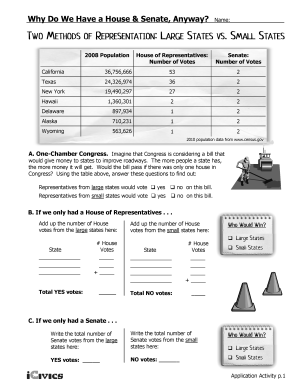
  • Determine the effect of a single-house system by analyzing data about state populations and the number of representatives in each house. 

Lesson Prep

Print
All student and teacher materials.

Step by Step

PREPARE by deciding in advance how you will split the class into groups. First, you will need to assign each student the role of either "teacher" or "student." You will need more students than teachers. Next, plan how you will create groups of "students" and "teachers." You will need more groups of teachers than groups of students. If your class is small, it's okay to have only one teacher in each "group."

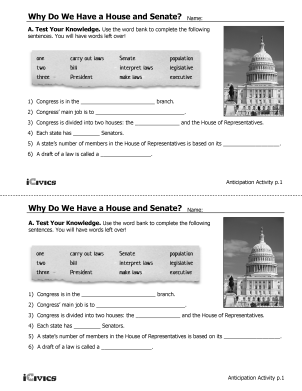
ANTICIPATE by having students complete the half-sheet activity. Review the answers to the questions about Congress.

EXPLAIN that the class will be doing a role-play activity to model the way Congress works.

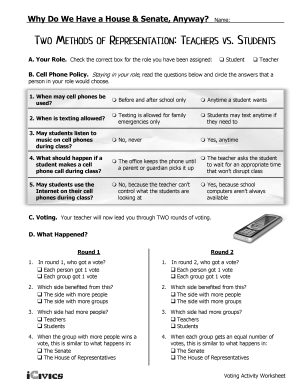
ASSIGN each student a role of "student" or "teacher" according to your pre-class preparation. Give each student a Role Card so they won't forget their roles.

DISTRIBUTE one voting activity worksheet to each student. Ask students to check their role and complete the Cell Phone Policy questionnaire. Be sure students stay in their roles when answering the questionnaire.

PROJECT the "Battle of the Plans" transparency. Poll the "students" and "teachers" on each question and mark the winning answers on the transparency to create two separate "bills" about a cell phone policy.

CONDUCT two rounds of voting and record the results on the transparency. In the first round, each person gets 1 vote. In the second round, each group gets 1 vote. ("Students" should win the first round and "teachers" should win the second.)

PROJECT the "Compromise" transparency. For each question, help the class decide on a compromise. Write the compromise on the transparency.

CONDUCT the final vote. Explain that in order to "pass," the compromise plan must win both rounds. (If it fails, discuss with the class what additional compromise might help.)

DISTRIBUTE one "Large vs. Small States" worksheet to each student.

READ the table and directions with the class.

ALLOW students to complete both sides of the worksheet. You may wish to work through the worksheet together as a class.

CLOSE by asking students to make comparisons between how Congress works (compromise between large and small states) and how the teacher/student voting activity worked.

Teacher Files:

There are no teacher files for this page.