


Use primary documents and images to discover the ways state and local governments restricted the newly gained freedoms of African Americans after the Civil War. Compare, contrast, and analyze post-war legislation, court decisions (including Plessy v. Ferguson), and a political cartoon by Thomas Nast to understand life in Jim Crow states.
Students will be able to:
ANTICIPATE by handing out the picture analysis half sheets and asking students to answer the questions. Discuss answers as a class, pointing out that it was taken around 1955. (If the students do not mention the term “segregation,” add it to the discussion.)
DISTRIBUTE the reading pages (2 sides) to each student.
READ the first page with the students.
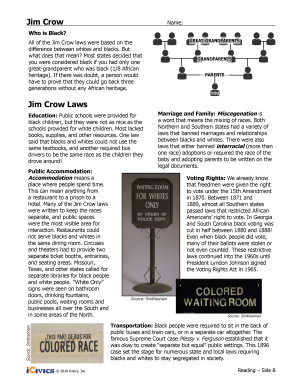
ASK students how the pictures on the left of the page are examples of segregation.
READ the first paragraph of the second page with the class.
FOCUS on the small family tree and walk through the diagram with the students. Explain that a person would be considered “black” if even just one great grandparent had African heritage.
COMPLETE the reading with the class, stopping to scaffold new vocabulary words as needed.
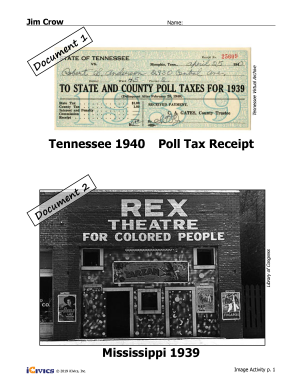
DISTRIBUTE the half page Image Activity Sheet to each student.
SHOW the ten primary documents (as transparencies or individual sheets) one at a time. Have students classify each document by circling the correct category on the half sheet. Afterward have students do the two questions at the bottom of the sheet.
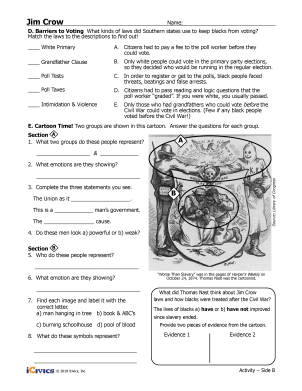
DISTRIBUTE the Jim Crow worksheet (2 sides) to each student. Have the students complete the activities on the worksheet. Note: some activities review material from the reading, and others introduce new concepts for students to work with.
EXTENSION (Optional) Distribute the reading on Resistance and read through with the class. Help students rate the approaches of Washington and Du Bois in terms of risk and in speed. Have students complete the Venn quote activity. Note: This activity provides a great segue into the lessons about the Civil Rights Movement.