Countries often work together to solve problems and fall into conflict when problems cannot be resolved. After learning about motivations and conditions that lead to action (or inaction), students analyze examples of international conflict and cooperation.
The student will be able to
ANTICIPATE by asking students to provide examples from their lives of “conflict” and “cooperation.”
DISTRIBUTE the double-sided reading page and the analysis chart.
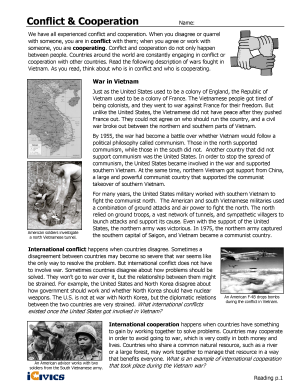
READ the first page of the reading, discussing key concepts as necessary.
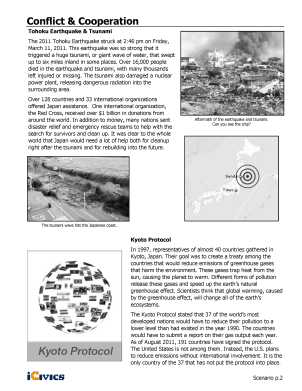
READ the second page of the reading. After reading each paragraph on page 2, use the following questions to complete the first row of the analysis chart as you go:
Conditions: What were the conditions that caused Vietnam to go to war against France? What conditions led to the civil war in Vietnam?
Motivations: What was the U.S.’ motivation for cooperation with the southern Vietnamese during the Vietnam War? What was China’s motivation for cooperating with the northern Vietnamese?
Actions: What actions did the U.S. take to cooperate with the southern Vietnamese? What actions did the North and South take against each other?
DISTRIBUTE the double-sided scenarios page.
ASSIGN the scenarios reading and completion of the chart to students individually, in pairs/small groups, or complete as a whole class activity.
REVIEW completed analysis charts as a class if necessary.
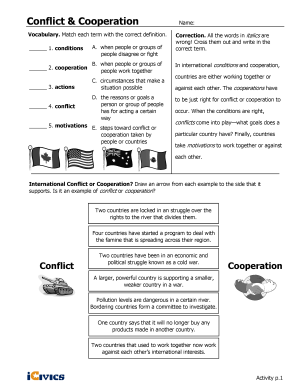
DISTRIBUTE the double-sided activity page and assign students to complete.
REVIEW page 2 of the activity page.
CLOSE class by asking some students to share the conditions, motivations, and actions of the scenarios they created.