

Why Government? Print All Related Standards

Description

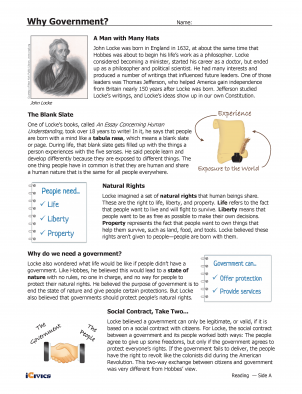
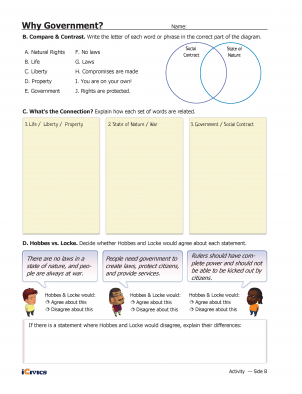
By illustrating and sorting captions, students follow the development of John Locke's theory on natural rights. They then become familiar with Thomas Hobbes’ statement about life in a state of nature by exploring their own opinions in comparison to those of Hobbes. Students learn the vocabulary associated with the philosophy of the purpose of government through an activity called “word math.”

Objectives

Students will be able to

  • identify natural rights in vocabulary activities addressing natural rights. 
  • analyze advantages and disadvantages of government through analysis of Thomas Hobbes’ statement on life in a state of nature. 
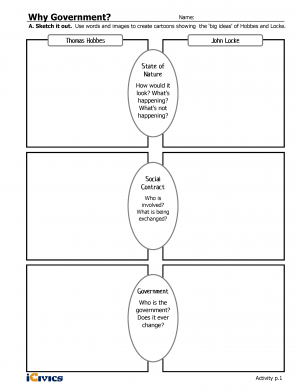
  • trace the development of the theory of government developed by John Locke through a drawing and sorting activity. 

Lesson Prep

PRINT
all student and teacher materials.

Step by Step

ANTICIPATE the lesson by asking the following question: “As a human being, what are your rights? What are things that you should be allowed to do?” 

DISTRIBUTE the activity pages to students.

INSTRUCT students to complete step one: drawing pictures in all nine boxes based on the descriptions on page one. 

PROVIDE students with ideas as needed. For example, drawing someone living might be difficult, but they could draw a baby, someone dancing/moving, or someone doing their favorite activity.

DIRECT students to cut out the caption cards in step two, and to match them with the correct pictures they drew in step one. 

DISCUSS each caption as you go, unpacking the meanings of each vocabulary word. 

READ through the completed comic strip with the students. 

DISTRIBUTE the worksheet to students.

INSTRUCT students to create a vocabulary list, assisting as needed. Allow students to complete the worksheet. 


Recommended Sequence

Teacher Files:

There are no teacher files for this page.