


The Road to Civil Rights Print All Related Standards

Description

Discover the people, groups, and events behind the Civil Rights Movement. Learn about means of non-violent protest, opposition to the movement, and identify how it took all three branches of the federal government to effect change. Protest posters, fictional diary entries, and a map of the movement's major events develop a greater understanding of the struggle for civil rights.

Objectives

Students will be able to:

  • describe the processes that led to the expansion of rights for African Americans.
  • identify the role of the three branches of government in establishing and protecting rights.
  • describe methods that civil rights activists used to protest segregation.
  • identify individuals and groups that influenced the Civil Rights Movement.
  • explain the significance of civil rights Supreme Court cases: Brown v. Board of Education, Loving v. Virginia, Bailey v. Patterson, Heart of Atlanta v. US.
  • explain the significance of the Civil Rights Act of 1964 and 1968, the 24th Amendment, the Voting Rights Act of 1965, and the Fair Housing Act.

Lesson Prep

PRINT
all teacher and student materials.

Step by Step

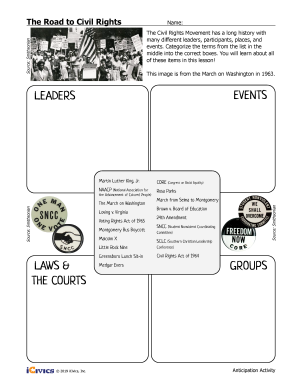
DISTRIBUTE the anticipation activity and have students classify the terms into the four categories. Ask the students to put a star next to terms they recognize and circle the terms that are unfamiliar. See how many terms can be collectively defined.

SHOW the “What If…” overhead/slide and ask for reactions from the students. (These historical scenarios will be covered through out the lesson.)

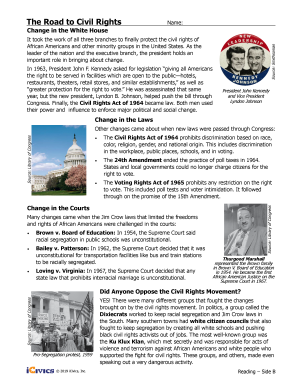
DISTRIBUTE the reading pages and read through the first page.

REVIEW the roles of the three branches of government before moving on to the second reading page. Then read through with your students. Ask them to select which of the laws or court decisions they think was the most important and share why. 

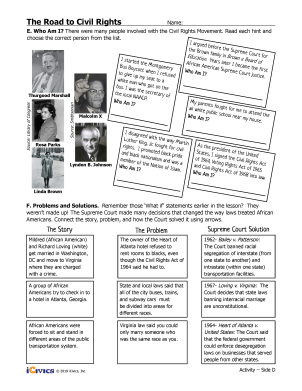
DISTRIBUTE the Activity Sheet 1 and explain the directions. (You can cut the cards into sets of 6 prior to the lesson, or give the half sheets to the students to cut for themselves.)

ASSIGN students to select the correct problem/solution set and attach it to the poster sheet.

REVIEW correct answers in student pairs or by seating groups.

DISTRIBUTE remaining activity pages and assign for completion as a class or for individual work. Diary entries are fictional accounts of the following historical events: 7. Montgomery Bus Boycott, 8. Greensboro Sit-In, 9. Selma-Montgomery March,10. Freedom Rides

REVIEW student responses to the activity pages as a class.

EXTENSION page has a map activity and more detailed information about the various organizations that developed during the Civil Rights Movement. Students will need access to a basic map of the United States to complete.

Recommended Sequence

Before: 

Teacher Files:

There are no teacher files for this page.