


Students learn that the rights in the Bill of Rights have no exact definition and are open to interpretation (by the Supreme Court, of course). Students look at real-life cases involving the 8th and 5th amendments and see whether they come to the same conclusion about each case as the Supreme Court did.
Note: this lesson includes two optional PowerPoint presentations (see Lesson Prep below).
Students will...
DISTRIBUTE one “What Does That Mean?” packet to each student.
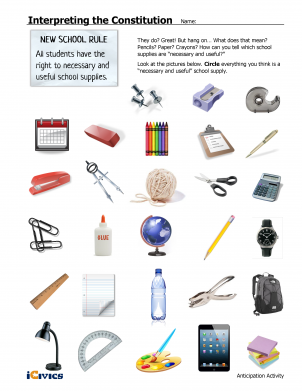
INTRODUCE the “What Does That Mean?” introductory activity and have students complete the worksheet by circling all the “supplies” they personally think would be covered by the rule. You may choose to have students complete this with a partner.
POLL students to get an idea what items they chose. Emphasize the differences among students’ choices.
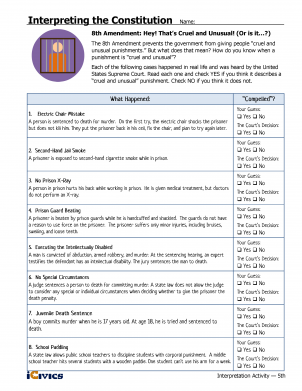
TURN to the “Hey—That’s Cruel and Unusual” checklist. Tell students they will be looking at eight real-life Supreme Court cases. Read the directions with the class, then let students answer. You may choose to have students work in pairs or to discuss each case as a class.
POLL students on each case. Write a tally on the board to keep track of how many students chose “yes” and “no” for each case.
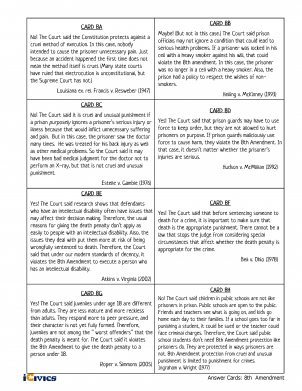
REVEAL the answers! Power Point Option: Use our ready-made PowerPoint presentation to reveal each answer. Turn up the volume so students can hear the drum roll and cymbal crash with each question and answer. Answer Card Option: While students are working, cut out and distribute the answer cards to 8 students. Reveal the answers by having students read what is on their cards.
REPEAT the activity for the “I Take the Fifth” scenario checklist. The cases are a bit longer with this one and the ideas are a bit more complex. You may choose to do only one of these during the class period.
COMPARE the poll to the actual answers. Were there any cases where the class came up with a different answer than the Supreme Court? Are there any cases where students disagree with the Court after knowing how the case came out?
RETURN to the introductory activity and tell students that “necessary and useful” now means “items a student cannot do his or her assignments without.” Have students cross out all circled items they think no longer meet the definition.
CLOSE by discussing their choices and whether the new rule made it easier. Explain that the courts help make rules easier to follow by clarifying what they mean in individual cases.